Sunday, June 24, 2018

Trade Is an Afterthought in a Stock Market Still Glued to Earnings

LISTEN TO ARTICLE 3:57 SHARE THIS ARTICLE Facebook Twitter LinkedIn Email

Of all the forces swaying equity prices, earnings expectations are the hardest to see. They don’t make headlines, are difficult to quantify and get lost in the din around trade wars and politics.

Yet ignoring them is to miss the biggest part of what influences the market -- the force that keeps the peace in a week like this. Stocks twist and turn, Donald Trump tweets about China and Europe, the Fed ponders higher rates. Then a five-day chart shows major U.S. indexes have barely budged, because nothing has happened to cause earnings estimates to change.

“It’s certainly muting some of the impact we might otherwise see,” Peter Jankovskis, co-chief investment officer at Oakbrook Investments, said by phone. “That’s giving hope to people that if things are resolved that we’ll be able to maintain that momentum, and that’s part of the reason that we’re not seeing the dramatic moves that we saw during the first quarter.”

Profit forecasts have been calling the tune in equities all year. According to Bank of America, a strategy that buys and sells shares based on earnings sentiment has beaten every other equity factor in 2018. Companies with the best estimate revisions have outpaced those with the worst by 13 percentage points.

Estimates keep rising. At present, analysts expect S&P 500 companies to earn $158.70 a share in 2018, $175.90 in 2019 and $193.70 in 2020. Each is up appreciably from the end of the first quarter. Using next year’s projection, the index’s price-earnings ratio -- above 21 based on profits in the last 12 months -- falls to around 16, smack at its historical average.

#lazy-img-328793608:before{padding-top:56.25%;}

Calm prevailed in the market during a week when Trump’s threat of tariffs on European auto imports and $200 billion of Chinese goods provoked promises of retaliation. The S&P 500 moved no more than 0.6 percent each day and ended the week down 0.9 percent, its first decline in one month.

None of this is to say investors are totally ignoring the trade drama. Underneath the tranquil surface, fissures have flared as money flowed out of multinational firms to domestic-oriented stocks.

The Dow Jones Industrial Average, including global giants such as Caterpillar and Boeing, slipped 2 percent for the worst week in three months. By contrast, small-cap stocks, which derive their revenue mainly from within the U.S., reached fresh records. Up eight weeks in a row, the Russell 2000 is enjoying its best run in almost five years.

#lazy-img-328793726:before{padding-top:56.25%;}

Within industries, trade is also dividing stocks. In tech, chipmakers are trailing internet shares. Among industrials, machinery manufacturers are lagging behind transports.

Yet all the rotations have done little damage to the broad market and the S&P 500 hovered near a three-month high. While no real impact from a trade war is expected for the second quarter, investors will look to the earnings calls to gauge the potential fallout, according to Joe “JJ” Kinahan, the chief market strategist at TD Ameritrade.

“We’d all be surprised if you didn’t hear a Caterpillar and a Deere and a Boeing sort of address it,” he said by phone. “The area of particular interest is going to be technology and more specifically semiconductors. Will they address it? Do they see it as being a hindrance going forward?”

Banks are scheduled to start the reporting season next month. Profits from S&P 500 companies are expected to increase 20 percent in the March-June period, analyst estimates compiled by Bloomberg show.

#lazy-img-328793753:before{padding-top:56.25%;}

A 10 percent increase in import costs from trade tariffs would reduce S&P 500’s per-share earnings by 3 to 4 percent, according to BofA strategists led by Savita Subramanian. Meanwhile, driven by tax cuts and improving demand, analysts are boosting their earnings forecasts at an unprecedented pace.

“The equity market has remained resilient despite rising trade tensions; fundamentals have trumped macro so far this year,” Subramanian wrote in a note earlier this week. “Scary headlines might be more hype than reality: as of now.”

Friday, June 22, 2018

Thank God! India among top EMs that show no signs of major financial stress

Global research firm, Nomura, has flagged concerns on financial stress in emerging markets (EMs) based on what it calls ��early warning indicators�� (EWIs). However, India, among other few Asian economies, is an exception as it showed no signs of stress in the past three years.

In a research note, the firm highlighted how emerging markets showed signals in the past 12 quarters, which qualified as EWIs. "Note that our EWIs are designed to warn of domestic credit and financial risks rather than balance of payments risk," it said in a statement. These EWIs flash a signal of a financial crisis occurring within the next 12 quarters when they breach predefined thresholds.

nomura india

Nomura noted that Asia was most at risk among these segments. On a nation-specific basis, Hong Kong tops the chart with around 52 signals in the past 12 quarters, while India, Korea, Hungary, and Poland were among the few nations that showed no signs of risk.

related news All options being considered to resume mining: Goa govt Markets@Moneycontrol: Indices close week on high note US apex court judge opines bitcoin could be used to dispense salaries in future

This is a major change from the conditions just before the global financial crisis when, in Q3 2008, the 12 DMs had a whopping 251 EWIs flashing red. Zooming in on Asia, Hong Kong looks the most vulnerable, with 52 EWIs flashing, up from 50 in Q3 �� more than during the peak of the Asian crisis.

��Buffers notwithstanding, Hong Kong has the classic symptoms of what have caused many past financial crises: an overvalued property market and high debt, leaving the city vulnerable to an accelerated Fed hiking cycle (local rates are closely linked to US rates because of the HKD peg),�� analysts at Nomura wrote in the note.

Meanwhile, it observed that China showed encouraging trends as indicators point to a peaking out of such threats. EWIs in China peaked in Q2 2017 at 36, before falling to 35 in Q3 and 33 in Q4.

This presents tentative evidence that financial deleveraging efforts are starting to pay off, Nomura added in its report.

��Credit and property gaps (from their long-run trend) have narrowed from 15.8pp and 28.0pp in Q3 2017, respectively. Overall, these are nascent signs that China��s policy efforts to crack down on shadow financing and property market speculation are paying dividends.�� First Published on Jun 22, 2018 12:40 pm

Wednesday, June 20, 2018

Zacks: Analysts Expect Kite Realty Group Trust (KRG) Will Announce Earnings of $0.50 Per Share

Wall Street brokerages expect Kite Realty Group Trust (NYSE:KRG) to announce $0.50 earnings per share (EPS) for the current quarter, Zacks Investment Research reports. Five analysts have made estimates for Kite Realty Group Trust’s earnings, with the lowest EPS estimate coming in at $0.49 and the highest estimate coming in at $0.51. Kite Realty Group Trust reported earnings per share of $0.54 during the same quarter last year, which suggests a negative year over year growth rate of 7.4%. The company is scheduled to report its next quarterly earnings results on Wednesday, July 25th.
On average, analysts expect that Kite Realty Group Trust will report full year earnings of $2.00 per share for the current fiscal year, with EPS estimates ranging from $1.98 to $2.02. For the next year, analysts anticipate that the company will post earnings of $2.04 per share, with EPS estimates ranging from $2.02 to $2.06. Zacks’ EPS calculations are a mean average based on a survey of sell-side research firms that follow Kite Realty Group Trust.

Get Kite Realty Group Trust alerts:

Kite Realty Group Trust (NYSE:KRG) last announced its earnings results on Wednesday, April 25th. The real estate investment trust reported $0.51 EPS for the quarter, beating the consensus estimate of $0.49 by $0.02. The business had revenue of $89.76 million for the quarter, compared to the consensus estimate of $88.38 million. Kite Realty Group Trust had a negative return on equity of 0.38% and a negative net margin of 1.69%. The company’s revenue was down .4% on a year-over-year basis. During the same period last year, the business posted $0.51 EPS.

Several equities research analysts recently commented on KRG shares. Robert W. Baird reiterated a “buy” rating and set a $19.00 target price on shares of Kite Realty Group Trust in a report on Wednesday, March 21st. Barclays reiterated a “buy” rating and set a $20.00 target price on shares of Kite Realty Group Trust in a report on Thursday, March 8th. TheStreet downgraded Kite Realty Group Trust from a “c” rating to a “d+” rating in a report on Wednesday, April 25th. Sandler O’Neill set a $15.00 target price on Kite Realty Group Trust and gave the company a “hold” rating in a report on Tuesday, April 24th. Finally, ValuEngine downgraded Kite Realty Group Trust from a “sell” rating to a “strong sell” rating in a report on Wednesday, May 2nd. One research analyst has rated the stock with a sell rating, six have issued a hold rating and five have issued a buy rating to the stock. The company currently has a consensus rating of “Hold” and an average target price of $18.57.

A number of hedge funds have recently bought and sold shares of KRG. Certified Advisory Corp purchased a new stake in Kite Realty Group Trust during the 4th quarter worth approximately $137,000. Bridgeworth LLC purchased a new stake in Kite Realty Group Trust during the 1st quarter worth approximately $171,000. SG Americas Securities LLC increased its holdings in Kite Realty Group Trust by 78.3% during the 1st quarter. SG Americas Securities LLC now owns 11,693 shares of the real estate investment trust’s stock worth $178,000 after purchasing an additional 5,135 shares during the last quarter. Xact Kapitalforvaltning AB purchased a new stake in Kite Realty Group Trust during the 4th quarter worth approximately $202,000. Finally, Element Capital Management LLC purchased a new stake in Kite Realty Group Trust during the 1st quarter worth approximately $240,000. Institutional investors own 93.75% of the company’s stock.

Shares of NYSE:KRG remained flat at $$16.60 during mid-day trading on Tuesday. The company had a trading volume of 802,779 shares, compared to its average volume of 776,956. The stock has a market cap of $1.38 billion, a P/E ratio of 8.14, a P/E/G ratio of 1.93 and a beta of 0.51. The company has a current ratio of 0.84, a quick ratio of 0.84 and a debt-to-equity ratio of 1.08. Kite Realty Group Trust has a 1-year low of $13.87 and a 1-year high of $21.57.

The firm also recently disclosed a quarterly dividend, which will be paid on Friday, July 13th. Shareholders of record on Friday, July 6th will be issued a dividend of $0.317 per share. The ex-dividend date of this dividend is Thursday, July 5th. This represents a $1.27 annualized dividend and a yield of 7.64%. Kite Realty Group Trust’s dividend payout ratio is presently 62.25%.

Kite Realty Group Trust Company Profile

Kite Realty Group Trust is a full-service, vertically integrated real estate investment trust (REIT) engaged primarily in the ownership and operation, acquisition, development and redevelopment of high-quality neighborhood and community shopping centers in select markets in the United States. As of December 31, 2017, we owned interests in 117 operating and redevelopment properties totaling approximately 23.3 million square feet and two development projects currently under construction.

Get a free copy of the Zacks research report on Kite Realty Group Trust (KRG)

For more information about research offerings from Zacks Investment Research, visit Zacks.com

Earnings History and Estimates for Kite Realty Group Trust (NYSE:KRG)

Tuesday, June 19, 2018

Hot Tech Stocks To Invest In Right Now

tags:ON,EVTC,DSGX,MITK,AMSWA,

Overview

In this series of articles, I will be taking a look at various industry sectors and selecting what I believe will be outperforming stocks for 2016. In the first article, I reviewed the airline industry and selected my top stock for next year which turned out to be Alaska Air Group (NYSE:ALK). For this second article, I will review the following Auto stocks:

Fiat Chrysler Automobiles (NYSE:FCAU) Ford Motor (NYSE:F) General Motors (NYSE:GM) Harley-Davidson (NYSE:HOG) Honda Motor (NYSE:HMC) Kandi Technologies Group (NASDAQ:KNDI) Tesla Motors (NASDAQ:TSLA) Thor Industries (NYSE:THO) Toyota Motor (NYSE:TM) Winnebago Industries (NYSE:WGO)

Step 1

The first step I took to narrow down the list of possible options was to look at the earnings over the past five years of these stocks within the industry sector. I removed any stock that had negative earnings growth over the past five years. The stocks with negative earnings include:

Fiat Chrysler Automobiles Ford Honda Motor Kandi Technologies Group Tesla Motors Toyota Motor

Step 2

Hot Tech Stocks To Invest In Right Now: ON Semiconductor Corporation(ON)

Advisors' Opinion:
  • [By Lee Jackson]

    Aggressive accounts may want to look at this smaller cap play. ON Semiconductor Corp. (NASDAQ: ON) is a vendor of analog power management, analog signal conditioning, standard logic integrated circuits and discrete chips into the automotive, communications, computing, consumer, industrial and medical applications. The company is in the midst of a transformation from a seller of commodity discrete chips into higher value added analog integrated circuits, both through organic growth and acquisitions.

  • [By Asit Sharma]

    Stock in semiconductor manufacturer ON Semiconductor Corp. (NASDAQ:ON) rose 13.8% in May, according to data from S&P Global Market Intelligence.

  • [By Shane Hupp]

    Cornercap Investment Counsel Inc. boosted its position in shares of ON Semiconductor Corp (NASDAQ:ON) by 39.9% in the 1st quarter, Holdings Channel reports. The firm owned 75,020 shares of the semiconductor company’s stock after buying an additional 21,395 shares during the quarter. Cornercap Investment Counsel Inc.’s holdings in ON Semiconductor were worth $1,835,000 at the end of the most recent quarter.

Hot Tech Stocks To Invest In Right Now: Evertec, Inc.(EVTC)

Advisors' Opinion:
  • [By Shane Hupp]

    Equities research analysts at Raymond James initiated coverage on shares of Evertec (NYSE:EVTC) in a report released on Friday, MarketBeat reports. The firm set a “market perform” rating on the business services provider’s stock.

  • [By Joseph Griffin]

    Evertec (NYSE:EVTC) was downgraded by equities research analysts at ValuEngine from a “buy” rating to a “hold” rating in a research note issued to investors on Saturday.

Hot Tech Stocks To Invest In Right Now: The Descartes Systems Group Inc.(DSGX)

Advisors' Opinion:
  • [By Max Byerly]

    Descartes Systems Group (TSE:DSG) (NASDAQ:DSGX) had its target price lifted by Barclays from C$43.00 to C$45.00 in a research report report published on Thursday.

  • [By Stephan Byrd]

    Descartes Systems Group Inc (TSE:DSG) (NASDAQ:DSGX) shares reached a new 52-week high during trading on Monday . The stock traded as high as C$39.94 and last traded at C$39.84, with a volume of 62385 shares traded. The stock had previously closed at C$39.71.

  • [By Stephan Byrd]

    Get a free copy of the Zacks research report on Descartes Systems Group (DSGX)

    For more information about research offerings from Zacks Investment Research, visit Zacks.com

  • [By Ethan Ryder]

    Descartes Systems Group (NASDAQ:DSGX) (TSE:DSG) was upgraded by research analysts at BidaskClub from a “buy” rating to a “strong-buy” rating in a research report issued on Thursday.

Hot Tech Stocks To Invest In Right Now: Mitek Systems, Inc.(MITK)

Advisors' Opinion:
  • [By Motley Fool Staff]

    Many consumers prefer to deposit a check on their smartphone instead of visiting a bank branch or ATM in person. However, most banks lack the technological know-how to make this process work. That's why thousands of them have partnered with Mitek Systems (NASDAQ:MITK), a leading provider of image capture and identity verification software that makes it possible for banks to offer this must-have service to their customers.

  • [By Brian Feroldi]

    In this episode of Industry Focus: Tech, host Dylan Lewis and Motley Fool contributor Brian Feroldi take a close look at GrubHub (NYSE:GRUB), BlackLine (NASDAQ:BL), and Mitek (NASDAQ:MITK). Find out what each company does, and how they do it so well; the biggest risks that each faces; just how big the growth runways are for these relatively niche players; which one is Brian's favorite of the three; and more.

  • [By Shane Hupp]

    Mitek Systems Inc. (NASDAQ:MITK) Director Bruce Edward Hansen sold 40,000 shares of the stock in a transaction that occurred on Wednesday, May 30th. The stock was sold at an average price of $8.73, for a total transaction of $349,200.00. Following the completion of the sale, the director now owns 81,135 shares of the company’s stock, valued at approximately $708,308.55. The transaction was disclosed in a filing with the SEC, which can be accessed through this link.

Hot Tech Stocks To Invest In Right Now: American Software, Inc.(AMSWA)

Advisors' Opinion:
  • [By Stephan Byrd]

    BidaskClub upgraded shares of American Software (NASDAQ:AMSWA) from a hold rating to a buy rating in a research report sent to investors on Monday.

  • [By Stephan Byrd]

    Get a free copy of the Zacks research report on American Software (AMSWA)

    For more information about research offerings from Zacks Investment Research, visit Zacks.com

Friday, June 8, 2018

Why General Motors Is Bringing Its Autopilot Fighter to the Masses

General Motors (NYSE:GM) has staked out a position as a self-driving leader via its GM Cruise subsidiary, which is gearing up to launch a fleet of self-driving urban taxis next year.

Soon, it will bring some of that technology to more of its retail customers. GM said that its Super Cruise system, a hands-off highway driving system similar to Tesla's (NASDAQ:TSLA) Autopilot, will be rolled out to all Cadillac models in 2020 -- and to GM's other, more affordable brands after that.

Wait, GM is going to start selling self-driving Cadillacs?

Not quite. Properly speaking, Super Cruise isn't "self-driving." It's an advanced driver-assist system that allows drivers to take their hands off� the steering wheel under certain conditions (like cruising on the highway in good weather). In the lingo of autonomous-vehicle experts, Super Cruise is an advanced Level 2 system, one that requires drivers to stay alert and ready to take control on short notice. (Click here to learn more about the levels of self-driving technology.)

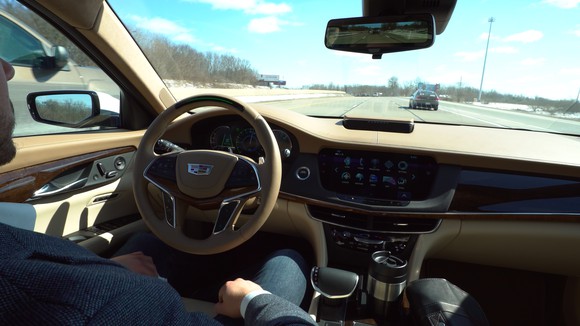
A view of the dashboard of a Cadillac CT6 that is cruising on the highway, showing the special steering wheel that is part of the Super Cruise system. The driver's hands aren't on the wheel.

GM's Super Cruise system allows hands-free highway driving under certain circumstances. Image source: General Motors.

Super Cruise's capabilities are similar to those of the current iteration of Tesla's Autopilot system. While Tesla CEO Elon Musk has made big promises about what Autopilot will become in the future, right now, Tesla officially defines it as a Level 2 system (albeit, like Super Cruise, an advanced one).

The difference between Autopilot and Super Cruise comes down mostly to user experience, and to the stricter limitations set by GM on its system. Among other things, Super Cruise incorporates several innovations intended to ensure that drivers are alert, and to get their attention when needed in non-annoying ways. GM launched Super Cruise as an option on the big Cadillac CT6 sedan last year. Reviews have been very favorable.

But it's important to make this clear: Vehicles with Super Cruise (or Autopilot, for that matter) are not "self-driving cars," despite what you may have heard.

If GM has already launched Super Cruise, what's the big deal?

Right now, you can get Super Cruise on the top-of-the-line Cadillac sedan, the CT6. But it's a $5,000 option that's only available on the top two trim levels -- or put another way, plan to spend at least $73,000 on your Super-Cruise-equipped Cadillac.

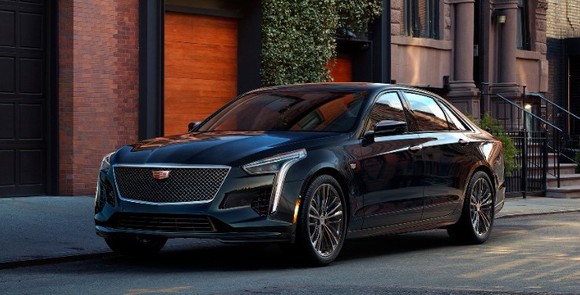
A black 2019 Cadillac CT6, a big luxury sedan.

Right now, Super Cruise is only available on the big (and expensive) Cadillac CT6. Image source: General Motors.

The strong hint with this announcement is that the price of Super Cruise will come down once it's rolled out as an option on other Cadillac models -- and it'll come down further once it's made available on more pedestrian Chevrolet, Buick, and GMC models.

How is Super Cruise related to GM Cruise, the self-driving taxi subsidiary?

It isn't directly related. GM was working on Super Cruise -- and had tentatively decided on the name -- long before it bought Cruise Automation, the San Francisco self-driving start-up that became GM Cruise. Development of the Super Cruise system is still done by a separate group within GM, though there may be some technology-sharing.

What's the upshot of this announcement for investors?

Reviews so far suggest that Super Cruise is a winner. GM has done a good job of building a safe, effective system that manages to be unobtrusive while ensuring that the car's human driver remains alert.

GM could probably sell a lot of cars with Super Cruise if it were more affordable, and if more people had the chance to try it. Expanding it to all Cadillacs, including lower-priced models like the new XT4 crossover, will make it possible for more customers to buy it. And expanding it to GM's other U.S. brands will make it widely accessible.

That's good for reasons that go beyond the profit that GM will make on vehicles equipped with Super Cruise. GM, with quite a bit of justification, wants to be seen as a technology leader within the auto industry. GM Cruise and the battery-electric Chevrolet Bolt EV have impressed critics and analysts, but so far only a few of GM's retail customers have been able to try (much less buy) Super Cruise.

Giving more people the opportunity to try and to own GM's advanced technology will only help boost the company's image as a technology leader -- which in turn should boost its profits and stock price over time.